
In this article
Democracy rarely collapses in a single dramatic moment. It erodes incrementally, quietly, and almost unnoticed by the average citizen. Think of the rise of authoritarianism in Russia, Viktor Orban’s 16-year rule in Hungary, and Poland’s shift towards a far-right government from 2015 to 2023 (the people of the latter two countries have since elected out these leaders). In these countries and now in the United States under the second Trump administration, democracy is dismantled through a series of corrupt dealings and unconstitutional overreaches by the government in power. Corporations that benefit from cooperating with the government spur on the decline of democracy.
“It is curious that physical courage should be so common in the world, and moral courage so rare.” (Mark Twain)
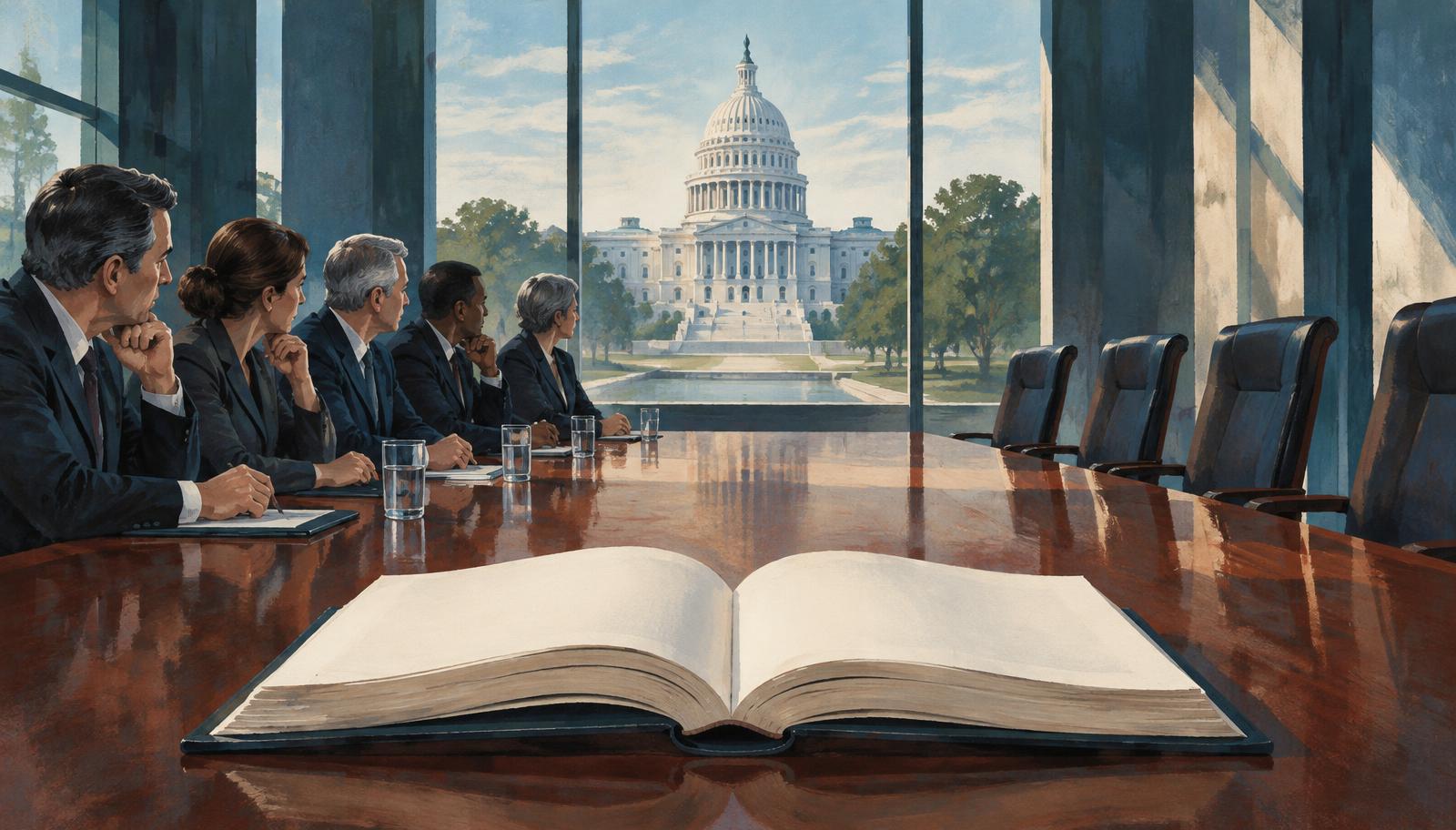
This is the topic Jacob Weisberg explores in his new book, Profiles in Cowardice: A Study of Collaboration in the Trump Era. Weisberg opens with a line from Mark Twain saying, “It is curious that physical courage should be so common in the world, and moral courage so rare.” With this quote, he is referencing the rarity of moral courage inside boardrooms, law firms, universities, and Congress to oppose Trump’s expansion of executive power during his second term. Weisberg explores these stories of compliance by narrating the role of eight individuals who hold important positions of leadership in institutions and companies instrumental to determining the resilience of American democracy.
Here at The Democracy Domain, we do something similar to Weisberg’s work. We track companies’ courage and cowardice in the context of the second Trump administration’s attack on democracy.
A Synopsis of Profiles in Cowardice
Weisberg tells the story of eight individuals who failed to push back when President Trump governed by executive order and enacted emergency decrees operating outside the democratic system. These individuals profiled are Jeff Bezos, Stephen Schwarzman, Brad Karp, former chairman of Paul, Weiss, Senator Mitch McConnell, Chief Justice John Roberts, media personality Megyn Kelly, George W. Bush, and Dartmouth president Sian Beilock. What unites these individuals, according to Weisberg, is not ignorance but power: each leads an institution or company with the ability to influence whether the United States remains a functioning democracy. These individuals, in Weisberg’s words, “absolutely know better” regarding the implications of their actions, but proceeded, nevertheless.
What unites these individuals, according to Weisberg, is not ignorance but power: each leads an institution or company with the ability to influence whether the United States remains a functioning democracy.
Weisberg starts his book with a simple definition of cowardice. If public courage is a principled choice made under pressure, then cowardice is the evasion of that choice. It is being absent and invisible at the critical moment. He identifies five forces that drove so many leaders toward cowardice in 2025. The first is peer pressure. Cowardice, like courage, is contagious, and once a few prominent figures cave, others follow. The second is fear of ostracism, especially for Republicans whose party is not just a label but a community, a donor network, and a career. The third is fear of violence, because Trump’s public attacks on his critics expose them and their families to harassment and threats. The fourth is money. Weisberg argues that for the billionaire class, financial threats and inducements shape moral posture far more than beliefs do. Friends of the president can expect rewards while his foes can expect punishment. The fifth is institutional responsibility. This is the instinct of university presidents and law firm chairs to “protect the institution” even at the cost of the principles it exists to serve. These forces reinforce one another, and together they explain how democracy dies, in Weisberg’s words, through “a thousand respectable, reasonable retreats”.
It was not always this way with Trump. Weisberg reminds readers that in Trump’s first term, the private sector acted as a real democratic guardrail. For example, big law firms sent pro bono teams to airports within hours of the first travel ban. Furthermore, after the Capitol riot on January 6, 2021, a score of Fortune 500 companies suspended political donations to lawmakers who objected to certifying the election.
Trump’s second term has been different. Tech and business leaders lined up at Mar-a-Lago before the inauguration striving to show loyalty and curry favor with Trump. For example, Meta, whose CEO Mark Zuckerberg had banned Trump from Facebook after January 6, paid $25 million to settle Trump’s lawsuit over the suspension. Then came what Weisberg calls a cascade of surrenders by law firms, universities, and corporations.
Weisberg details eight of these cases ranging from business and law to media, politics, and academia. First, after Trump issued an executive order barring Paul, Weiss lawyers from government buildings and stripping their security clearances, then-chairman Brad Karp struck a deal with the White House within five days. Weisberg calls it a “disastrous decision” in that the firms that resisted similar orders won every case in court and, he argues, are doing better than Paul, Weiss. Capitulation, in other words, is not always the safest move. Second, Blackstone founder Stephen Schwarzman had said in 2022 that he would not back Trump again, but then endorsed him in 2024. Weisberg reads the reversal as self-interest more than conviction, and faults Schwarzman and Wall Street for standing by in 2025 as tariffs and government shakedowns of companies eroded the free-market order they claim to believe in. Third, Jeff Bezos has a similar story to Schwarzman. In 2017, he refused Trump’s demand to make The Washington Post “more fair” to him. By 2024 he had blocked the paper’s planned endorsement of Kamala Harris, and weeks after a Mar-a-Lago dinner, Amazon agreed to pay $40 million for a documentary about Melania Trump, a deal Weisberg describes as a bribe dressed up as a business transaction.
The figures from media and politics show how personal grievances and partisan loyalty can override principles. Megyn Kelly confronted Trump about his treatment of women at a 2015 debate and endured a wave of harassment and threats as a result. Nine years later, she stood beside him at his election-eve rally and endorsed him as a protector of women. Mitch McConnell privately held Trump in contempt and called the January 6 certification the most important vote of his career, yet he voted to acquit Trump at his second impeachment trial. Weisberg argues that McConnell traded the Senate’s independence for a conservative judiciary, leaving Congress powerless to resist Trump’s rule by decree in 2025. George W. Bush, meanwhile, has never publicly criticized Trump. Even when Trump froze PEPFAR, the AIDS relief program widely considered Bush’s greatest achievement, Bush appeared only in a private farewell video for laid-off USAID staff and would not name the man responsible.
The final two profiles concern institutions meant to check executive power. Dartmouth was the only Ivy League school that did not sign a joint letter from more than 665 institutions opposing the administration’s interference in higher education. According to Weisberg, the administration left Dartmouth alone because Beilock had called the police on a peaceful 2024 Gaza protest, and she protected her institution too narrowly, at the cost of the academic autonomy Dartmouth once helped define. Finally, Chief Justice John Roberts wrote the 2024 opinion granting presidents broad immunity for official acts, and in 2025 his Court sided with the administration, at least in part, on all but one of its thirty-two emergency requests, often without explanation. Across all eight cases, Weisberg’s verdict is the same in that these leaders understood what was at stake and chose to bend to Trump anyway.
How The Democracy Domain Furthers Jacob Weisberg’s Work
While Weisberg writes about the people leading the institutions and companies with the power to resist Trump’s erosion of American democracy, The Democracy Domain focuses on giving every American the information to support companies that resist the administration’s overreach and avoid those that capitulate to it.
Power doesn’t just live in government. It lives in boardrooms, in corporate decisions, and in companies shaping our lives. Those companies depend on us, their customers, to keep their businesses running. That is why our app, Spend4Democracy, looks at media, financial services, retail and commerce, medical services, and social media companies the American people interact with daily.
Our app builds a record of how these companies behave when democratic norms are on the line. Our database tracks public statements, donations, regulatory actions, and credible reporting that connect companies to the administration’s anti-democratic actions, or, crucially, show them resisting its overreach. Weisberg’s book focuses on the institutions and companies that capitulate, but we believe that the firms fighting back also deserve positive recognition.
Weisberg notes that intimidation often goes unpublicized, which keeps fear invisible but ever present. It takes courage not only to face such threats, he writes, but to expose them. Making corporate conduct visible is exactly what our database is designed to do. Meta’s $25 million settlement with Trump in January 2025, most of which went to his presidential library fund, is one story we track, alongside many other events for Meta.
Make Courage Contagious
Perhaps the most challenging part of Profiles in Cowardice is that it does not let readers off the hook. Reviewers note that the book asks us to examine our own instincts, silences, and thresholds for action.
This need for self-reflection is the reason why The Democracy Domain was created. Most of us will never run a law firm, a university, or a corporation. Yet every purchase is a small choice we can make to support a company or boycott it. Democracy is upheld through millions of these small actions, not only on election day. If financial pressure is what motivates powerful business and university leaders (as Weisberg argues), then consumers hold a special kind of pressure of their own. Together and with intention, we can reward the companies that stand firm against democratic erosion and raise the cost of capitulation.
Democracy is upheld through millions of these small actions, not only on election day.
As Weisberg shows, cowardice spreads by conformity. The same is true of courage. Our goal is to give people the knowledge to act, and to be courageous one choice at a time.
Install the Spend4Democracy app to see how the companies you interact with measure on the democratic scale. The app includes:
- Company profiles show how individual brands rank against others in the same category, with the events behind their score.
- Category tracking shows how your own spending, from groceries to streaming, adds up.
- Alerts let you know when a company’s behavior shifts in ways that matter.
- Better alternatives point you to companies that more closely reflect your values.
Your Spend4Democracy profile puts all of this in one place. Add the companies you interact with most, from your bank and your grocery store to your streaming services and social media accounts. Then the app calculates your Democracy Impact Score which is a picture of how your everyday spending lines up with the democratic values you care about. As companies make new choices, your score updates, so you can see where your money is supporting courage, where it is rewarding capitulation, and where a better alternative is within reach. Weisberg shows what happens when the powerful decide that no one is watching. Your profile is how you start watching.


